Friday, 19 July 2013

Campus Happenings

Shame on me!  It's been a week since my last post and I had planned to post 2 blogs per week.  Shame!  It's also 4 weeks since I left Adelaide.  Time is slipping by rapidly.  I suppose I could split this posting and claim 2 posts this week - but that wouldn't count.  So ...  it's a biggie.
 
In some ways it's been just another week and although full, not necessarily full of things which are especially newsworthy, so I've bundled together something from last week with the news of this week.  Most readers wouldn't know, those pictured would, and they might think that I've lost track of a week, so I'll confess now to "bundling" the weeks.  Our "base load" is taking the "Matriculation English" classes for the new students before they can start the new Semester, and encouraging staff and those students who are around before classes start to engage in some English conversation. Laurel has distributed dozens of little "Can we please speak English for 5 minutes?" signs around the office work places and where students gather, and for many it has "broken the ice".  That's our regular and ongoing activity, and what follows is news of what is out of the ordinary for us.
 
Two weeks ago I and Laurel, my English teacher colleague and fellow Adelaidean, went to watch two of our University students compete in a cooking completion.  They are not "Food Preparation" students, they are studying a B.Ec. degree in Hotel Management, but cooking is a passion.  There was a "theme" to the competition - all dishes had to be based on "bean curd" (tahu, tofu etc).  I could not see this being particularly interesting, but I was wrong! 
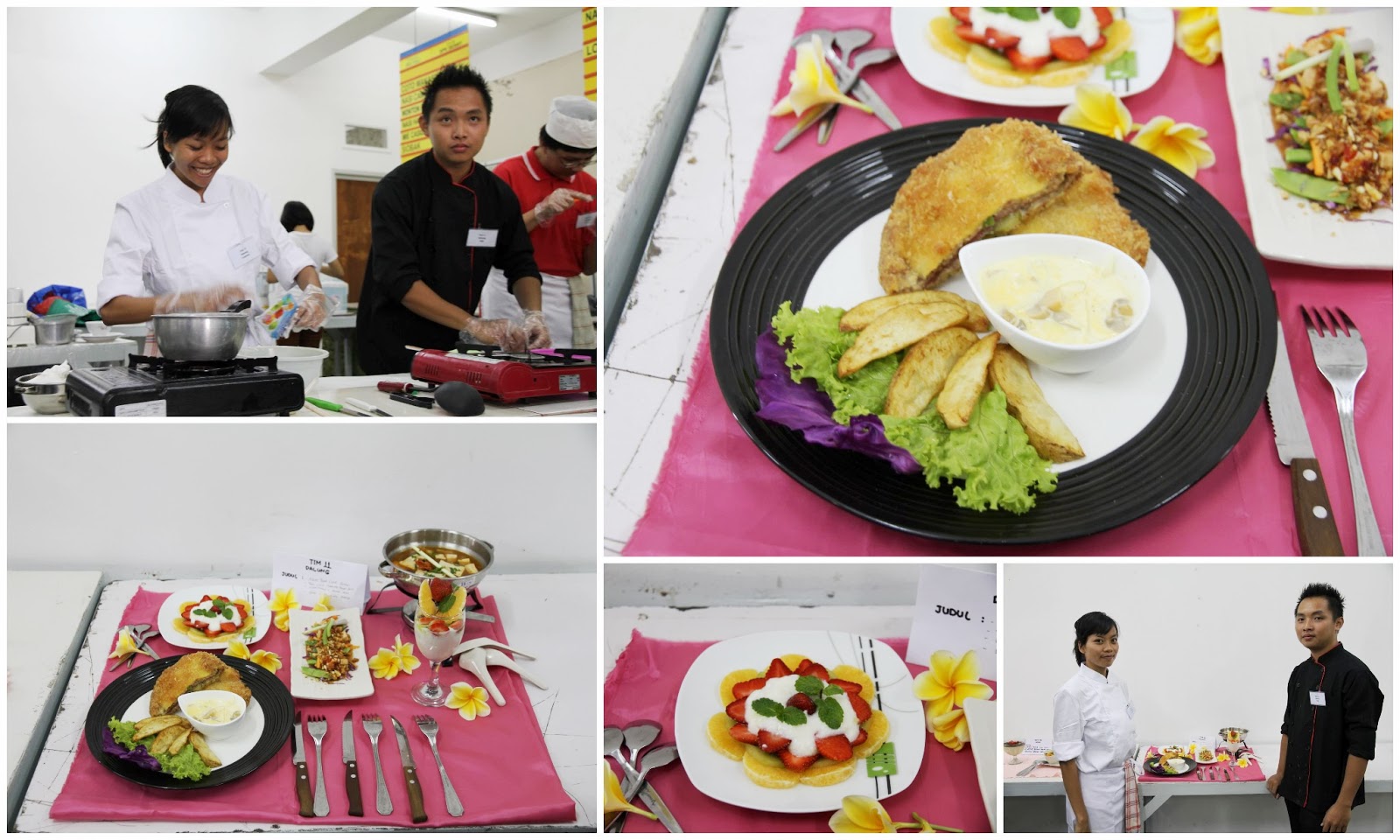
 
Yustina and Adji in action, and their winning 4 course dinner.
Their presentation matched the food quality, and they won the prize (no pix - presented at a later date).  Well done.  Yusti and Adji were behind the farewell barbecue arranged and catered for by several students last year.
 
Just to show me that their "bean curd" dishes were edible as well as attractive they came to our communal kitchen and prepared 3 of the 4 courses for us.  Laurel and I, Yusti, Adji and Vivi enjoyed a banquet (compared to our usual fare) of Thai style Tom Yang soup with tahu, a "cordon bleu" with tofu in place of veal, and a strawberry fruit pudding.  It was a wonderful, friendly gathering and I hope they will treat us to another such occasion (hint, hint!).  Thankyou Yusti and Adji.
 
 
Vivi watches on as Adji (left) and Yustina prepare the "bean curd banquet"
Someone always manages to sneak a "V" salute into the picture.
We manage in our kitchen, but it won't make it into the "life style" magazines.
 
We salute our cook - Yustina.  She's rightly
proud of this attractive and delicious dessert.
Whilst on the topic of food, I should mention another "food related" change this week.  For years the "student canteen" with simple "warung"-style food vendors has occupied the ground floor space below the classrooms.  It was quite simple, and, for me, there wasn't much variety.  Now the space is under conversion to IT service area and Physiotherapy Laboratorium (see photo in last blog; work almost complete). 
 

Look, no students - a rare sight, even on weekends
(photos from previous visits)
The old motor bike racks along the eastern fence line have gone and the space now sports a long block of shutter-fronted "lockups".  At the end closest to the main gate and lobby (for those who know the campus) is the new photocopy and offset print shop.  It's currently very busy as students about to graduate print cpies of their now-approved theses, and staff prepare course notes for the semester which starts in August.  All the other spaces hold small warungs, eating spaces, and a little store.  It's already starting to get busy.
 
Look, up in the sky: it's a bird ..... etc.  Well, no "Superman" but an increasing number of kites are appearing now that the winds have started blowing steadily from the east as is normal for this time of the year.  In the past month there have been many days with no kites visible, but now they are taking to the skies again.  Many will stay aloft for 5 or 6 weeks, perhaps longer.  When the winds drop they may fall down, but in past years the east wind blew for a couple of months and the kites stayed up there.  Mid-week a huge black "eagle" appeared high above the rice field just to the west of the campus.  Because of its height it's hard to estimate its size accurately, but I'd guess it is more than 2 metres across.  It's an impressive sight.  Each week more will appear and on weekends I'll again see trucks carrying teams of villagers holding on to their large communal kites as they travel to the kite grounds to launch them. 
 
See my blog of August 2011 "What's up - kites, of course"
 
Whilst Laurel and I are volunteers and support ourselves here, we are each provided with a comfortable large room and occasionally we enjoy "fringe benefits".  Last Monday evening we enjoyed one such benefit when we joined the "cultural night and dinner" provided to honour the visit of a team from the "EMS" (Evangelical Mission Solidarity), a Stuttgart based organisation representing many German churches.  The EMS and its constituent churches is a partner of the GKPB (The Protestant Christian Church in Bali), as is my own denomination, the Uniting Church of Australia, and has given a great deal of support to the GKPB.  The German guests,  the Bishop and many members of the governing Synod, many staff of the university, and some associates, assembled in the training restaurant.  After some welcoming remarks we were treated to 2 graceful dances performed by girls from the nearby Widya Asih 4 Orphanage (many of the girls are present or past scholars of the University and training college).  The first was a dance of welcome displaying the characteristic Balinese dance elements and the second was a recent liturgical dance representing the angels announcing the gospel ("good news") to the people of Bali.
 
Dancers welcome guests in traditional Balinese style
The Rektor, Dr Nyandra (rt), presents a momento to EMS
delegation leader Rev Jurgen Reichel and Hans translates.
Our "angels" spread the good news of the gospel across Bali

The graceful welcome and "angel" dances were performed to recorded music.  The final dance, the "Janger", was the longest and most vigorous, and it was accompanied by the wonderful sound of a gamelang band in full flight.  It was the first time I've seen such an energetic, foot-stomping dance with a band really "belting it out".  It was sheer excitement, Balinese style!
 
The 6 male and 6 female "Janger" dancers file in.  The foot-stomping
of the larger male dancers really rocked the building!


The girls show some of the more graceful moves whilst
 the men at the rear keep up a steady stomping rhythm


The male "Janger" dancers slap out the rhythm.  Our dinner waits in the background.
This was an exciting and colourful start to our "cultural night".  The dinner which followed presented another aspect of Balinese culture.  Around campus it's almost a case of "food with everything".  It was a wonderful evening.

On Thursday evening (18/7/13) whilst in our rooftop garden just before sunset I saw something I've never seen before.  Usually tropical haze, low cloud, or just plain smoke obscures everything more than a kilometre away.  Not on this night.  Gunung Agung (Mt Agung), the highest and 'chief' mountain in Bali, was visible to the north east.  In about 11 months spread across 4 visits I've only once caught a glimpse of it first thing in the morning, but never in the evening.  It's over 30 km away and usually well hidden.  Not only Agung, but also the two smaller mountains to its north-west were also visible.  And if that was not unusual enough, far in the west, the setting sun was lighting up a mountain most of the way to the western tip of Bali.  We had to consult a map to work out what we had seen, and it was almost too difficult to believe, but we had indeed seen something amazing.


Gunung Agung, Bali's highest mountain, seen from the rooftop garden,
Universitas Dhyana Pura.  The power cables just could not be avoided.


In my blog of last Friday I noted the arrival of the new "access points" for the University Wifi.  During the week the plain  covers of the devices were replaced with customised covers and I suspected that the new service would soon arrive.  Well, it's here!!!   Laurel and I are "trialling" the system to ensure it is working properly prior to the official commissioning, and for us it's a labour of love.  What a relief it is to have a service which operates a bit faster than a carrier pigeon with a broken wing.
 
After years of slow communications, this is a beautiful sight

That's been weeks 3 and 4 at Undhira Bali.  We are looking forward to a weekend outing, and then another week in our wonderful world of English conversation where we try explain some of the peculiarities of the English language and demonstrate to our staff and students how to pronounce sounds unfamiliar to them - especially "th" and "v" sounds.
 
Best wishes and "sampai jumpa"
Paul in Bali
 
PS
Although it's not "campus activity", I should acknowledge the enjoyable dinner of home-prepared "spaghetti marinara" I shared with my friends Hans and Imelda Mbot on Wednesday.  Imelda lived and studied in Italy for several years and knows a thing or two about how to prepare good pasta.  Thanks for the meal, the company, and the long but extremely cautious motorcycle ride from and back to campus (I didn't shut my eyes, scream or gasp once).
 
After a home cooked dinner with Hans and Imelda.  Note my
"casual crouch" so I'm the right height for the photo frame.
 

Friday, 12 July 2013

Signs of the Times (and other changes)

Although this is “Day 21” (but who’s counting) and I feel well settled in, I’m still coming across many changes.  Some are big, significant and quite unavoidable.  Others are small and subtle but important in their own little ways.
 
Three weeks ago as I first (for this trip) drove to the University through “my town” of Dalung some changes were apparent.  The traffic lights had large "digital countdown displays with green and red figures indicating the remaining times on the green or red lights respectively.  It seemed a waste to me as few people bother about the colour of the light anyway. 
 
No doubt the engineers thought they would be useful.
I'm not sure anyone even notices them because
traffic still streams through on the red.  Why wait?
 
There was a little shopping cluster here and there which had popped up since I left 9 months ago, and an illuminated windmill announced the presence of the “Holland Bakery”.   It's part of a chain in Bali, perhaps elsewhere in Indonesia, and I hope as much effort has gone into the contents of the shop as into the roof feature!
 
Even a poor streetscape isn't really
improved by something like this. 
 There has been a subtle change in the mix of shops – small western-Asian mix cafes, bakeries (some relatively expensive and not well stocked),  “children’s spas”, boutiques, specialty pet stores and clusters of new ATMs point to a rise in disposable income (at least for some of the population, probably those building the new villas which are spreading across the old  rice fields). 


View into a new small shopping court across one of the last rice fields on
the main road.  It has some good little shops, one of which produces a
 most enjoyable pizza (for "film night") and a new cafĂ© called Bamboe
(but the B keeps falling down), as well as a row of old-style street warungs.
Elsewhere there are still plenty of makeshift and rundown little shops and stalls showing that not all have shared in the rising fortunes of the town.  The state of the footpaths has generally improved although after 3 years and 4 visits I still have to take a long step over the “black pit” where the large cement panels covering stormwater access ports has been lost.
 
On campus (or “Kampus”) the major changes involved radical restructuring of senior management positions.  Time will tell just how well this will work.  There are several new faces on the staff.  Most of the anonymous doors I opened in the past when looking for people now sport new signs and it has made finding people so much simpler.  Most offices are labelled, signs  in the grounds point the way to “reception”, “motor cycle” parking area (as distinct from cars) etc. 
 
An important sign - the office of the "English Studies" lecturers

In past years I walked past this door many times without
realising we had an operating language laboratory.
In place of the somewhat “minimal” (understatement) student canteen are two new office suites and the displace canteen and lunch area now has a new home in place of the demolished motor bike shelters.  Some changes have had a ripple effect as change A prompts change B which leads to ….. On the oval and in other grassed areas there are groundwater recharge points which look a little like the "hole" or "cup" in a golf green, but with a little grill across the top.  This is to direct rain water (which would otherwise run to waste via drains) back down into the ground.  That's a useful and so simple improvement.
 
Meanwhile the cablers have finished installing the new “wireless access points” (WAP) to provide stable, reasonable speed WiFi with good coverage on campus, particularly in our building.  We’re still waiting for the link with the outside world to be completed, and it could be soon (but then again, it might not be – Boo!).
 

The new ceiling mounted WAP in the corridor just outside my door.

Meanwhile up on the roof .... I think I've discovered why progress
has been a little slow today. No, it's not an industrial accident.

Along the eastern wall of the grounds little businesses come and go.  Each year I’ve used a “new” laundry as the old one folded – often as a result of rising rents now that the street has been resurfaced and gained drains. 
 
Some of the warungs (small and simple food shops or perhaps just temporary screens around a trestle) have gone, but dear old Warung Bali, run by Pak Wayan and Bu Made is still operating.  My heart sank on my first day here when I saw the shop was closed, but they just were away at a ceremony in the home village.  Even Warung Bali has had a change.  The old hand written “menu board” has been replaced by a nice printed metal sign carrying their “offerings” – and there is even a new item on the menu: Ayam Betutu ("spicy" chicken, although I find almost everything somewhat spicy).
 
Warung Bali (2010).  Campus is on left of the street.
 
The new menu board has replaced the old sign.
Last night when wandering just before sunset I came across perhaps the most surprising change of all.  On the edge of a rapidly expanding residential area just 150 meters from the eastern entrance of campus I came across the “Bali Tulip" Hotel and Restaurant.  A hotel in Dalung?  Well I never – who would have expected that?  The decorations outside proclaimed an opening date of 23rd June but inside workmen were still preparing the buffet area.  Out of curiosity I enterred and found that they have 18 rooms at 299,000 IDR (Indonesian Rupiah) per night.  It had a pleasant, modern, business-boutique appearance to it, but regardless of style I was surprised by its mere presence.  Well, good luck to it.  Dalung has a hotel!


The new "Bali Tulip" Hotel
www.balitulip.com
Just past the hotel there was a flurry of building activity and several newish houses (the local people live in "houses", but similar dwellings are usually “villas” for expats – it sounds more exotic!).  I explored the rice fields in this area on my first weekend in Dalung in 2010 but had not been back until now, even though it starts just a couple of hundred meters from the campus gate, but in a direction I rarely travel.
   
There was a change I’d hoped to see but was disappointed.  In 2010 I gained a great deal of enjoyment from watching the cycle of the rice crop, from planting to harvest, in the rice field beside the western driveway (see 2010 Blog “Why am I watching the rice field?”).  In 2011 and 2012 this rice field had become a vegetable plot of much less interest to me.  I was told that the farmer had swapped usage as those seasons were very dry.  At present this season isn’t dry but it seems that the field has ceased to be a rice field and is now a vegetable field.  Pity.  It was a treat watching the rice grow but watching the beans grow isn’t quite the same.

The rice field as I remember it from 2010.  A beautiful sight.

On the left it's the same field but not the same "view".
Vegetables may be more profitable, but not as pretty.
The black poles along the driveway are very new.  They
support what I hope is a new fibre optic cable (internet).
Some things haven't changed much.  The roads are still packed with motorcycles; in the early morning and the evening I hear the Imam's call to prayer (there is a mosque not far away); when the gamelang band rehearses, the sounds drift into our building and delight me; the pop bands on stage at the Dalung Fair are just as loud as in past years  and the "Dangdut" music (a mix of Middle Eastern pop music, Western rock, hip-hop, contemporary R&B and reggae all starts to sound the same after 2 hours!  Fortunately there's a strict 10 pm curfew.  (The small fair runs for 3 weeks at this time of year - at other times the Balinese cattle graze on the open land).
 
And speaking of “change”, it’s time for me to “change” out of my orange-brown Staff “Friday shirt” (I wear the old 2011 “blue” staff shirt on Wednesdays!) and long trousers into more comfortable shorts and polo to relax.
 
Until next blog, “sampai jumpa”
Paul in Bali 

Monday, 8 July 2013

Dies Natalis ke-2 - Happy 2nd Birthday Undhira!

Yesterday (Sunday 7/7/13) was the second anniversary of the granting of the official charter which brought Universitas Dhyana Pura ("Undhira Bali") into being.  That was just a couple of weeks before I arrived on my second assignment and folk were still excited about what lay ahead. 
 
I was present at the "Wisuda" (formal presentation of degrees) on 12/8/11 when Dr I Wayan Mastra (Chairman of the Dhyana Pura Foundation) received the document.  It was an exciting and inspiring moment, but the magnitude of the task ahead was not forgotten.
 
Dr Mastra receives the document bringing Undhira Bali into existence
 
Planning for this day began long before I arrived last month and I've seen both staff and students preparing in many ways in the last 2 weeks.
 
A section of the choir at rehearsal
 
Choir and audience sang the Undhira March and Undhira Hymn
Bu Laurel (Milner) and Pak Paul joined the choir at rehearsals so we could acquit ourselves well on the day.
 
Signs and decorations liven up the western
entrance.  Volunteers live on the top floor of
 this building (53 steps several times per day!)
The main entrance and foyer.  The painters
 were busy late on the eve of celebrations to
ensure this approach was all in good order.

I normally approach this staff member when
I need material photocopied but here he is
preparing traditional decorations to line the
driveway to the western entrance.
On Saturday most staff and many students were on campus rehearsing roles, cleaning and tidying, making and fixing decorations and putting up signage.  Rehearsals and activities continued on Sunday afternoon and in the evening many groups were still preparing for the feast for the Dies Natalis (the "day of birth"  - we usually associate the term with Christmas Day).  The students below worked well into the evening slicing, stripping and shaping sugar cane into the flat sticks to be used for the Balinese sate.  The sticks are often bamboo or other cane but the soft sugar cane adds extra sweetness to the meat which is pounded with spices into a paste and squashed around the flat stick.

The boys cooked the sate over coals assisted by
 a small electric fan (literally fan forced cooking)
Most staff and students arrived at 8 am to take up places and have last minute rehearsals before guests arrived for the worship service at 9 and then the formal speeches by civic dignitaries at 10.

The University Rektor Dr I Made Nyandra (centre)
is interviewed by Bali TV before the ceremony.

Bu Christine looks sparkling in her important role as MC
The worship service ran promptly and the choir acquitted itself very well.  Dr Ketut Waspada, the current Bishop of the GKPB (the Christian Protestant Church of Bali) spoke.  Dr Waspada is the composer of Undhira's Hymn and March.  
 
After a short break many of the government officials arrived for the second part of the formal ceremony.


The Bupati (chief government officer for the
Regency of Badung) examines the document
of charter, watched by Dr Nyandra (right)
Three students of the University presented a traditional Balinese dance of welcome during which a small earth tremor rocked the building (actually just gave it a bit of a buzz) and alarmed a few guests who felt safer outside.  The Rektor and the current Foundation Chairman helped blow out the candle on a traditional Balinese cake bearing the number "2".


You have never seen a prelude to "cutting the cake" like
this one:  Balinese dance and accompanying earth tremor.

Now blow out the candle before there's
another tremor and we have to leave!
During the ceremony staff with recognised publications, research grants and study trips were recognised, as were representatives of successful student groups such as the Futsal, Basketball and Debating teams.

Steven, Yustina and Evan display certificates recognising
the Debating Team's success in the Provincial competitions.
Although the Rektor's speech on achievements and initiatives was in Indonesian, there were enough English words to give me clues, and the excellent video presentation showed me much which I had not yet learned and could be proud of which was as yet unknown.   The Bupati (Chief Officer of the Regency of Badung - one of the 8 Regencies making up the Province of Bali) gave a lively and entertaining speech which was greatly enjoyed by the guests, but sadly not understood by me.  At one point the Bupati asked me if I understood what he was aying, to which I had to confess "no".  He was kind enough to invite me to his office, so I shall look forward to the visit.  At about 1 pm the ceremony concluded and guests made their way to the campus training restaurant to enjoy the feast of many kinds of Indonesian food made from 30 traditional ingredients.  It was just delicious.


The fruit and vegetable decorations were
carved by students of the Hospitality
Studies component (PPLP) of Undhira
Happy Birthday "Undhira Bali".  You have come a long way in a short time but there are still many dreams yet to be fulfilled.  I'm proud to be able to play even a small part in your present and future.
 
Paul in Bali


Sunday, 7 July 2013

Bali Deja VU … Vu ….. vu ……

Despite initial expectations of an early resumption of blogging activity …… it didn’t happen!  Today is now my 16th day away from home and life here is much the same as on the past 3 trips.  It didn’t take long to slip back into the Bali campus relaxed life style and exchange the cold and wet of Adelaide’s winter weather for the warm (sometimes hot already) and humid climate here. 
Bali13_C7D_0279
 
Bali13_C7D_0275
 
My pictures for my first trip in 2010 began with a pair of pix like this.  Now the airline has changed names and the flight number is different but my feelings on leaving were similar – some sadness at leaving family behind, especially our young grandson, Cameron, who may notice that his poppa isn’t there to babysit him at present; some excitement at renewing friendships and resuming a very rewarding role as a volunteer English Conversation Coach / English Teacher at Universitas Dhyana Pura (“Undhira Bali”).
 
The flight was quiet and uneventful (the way I like it – who needs on-board dramas?).  At about 5 hours into the flight we rounded the end of the Bukit Peninsula and began our approach to Ngurah Rai Airport, Bali.  I was there again.

A good view of the Bukit Peninsula as we swing onto our
approach path.  The window is unusually clean and lacks
the usual scratches which usually hamper photography.
 
Friends from previous trips, Hans and Imelda Mbot met me and drove me to Seminyak where I stayed for 2 nights before going up to the Dalung Campus on Monday morning.  Hans, Imelda, Ferry (our driver) and I enjoyed dinner at a local cafe which was showing the first test between Wallabies and the English/Irish Lions.  They had never seen a Rugby match and thought that a fast moving fight was being broadcast – perhaps they weren’t far wrong.
 
Seminyak Beach in the early morning - before the crowds.
Seminyak Beach on a balmy night at sunset
 
The Kuta district just doesn’t appeal (don’t start me on it!).  Seminyak, a few kilometres north along the broad beach,  is much nicer and more relaxed (and that’s not just my age speaking).   The beach is pleasant at both ends of the day, particularly so when there’s a nice bit of colour in the sky at sunset.
 
OK, 2 days done.  I've "broken the ice" - not that there's much of that here, of course.  Just 98 more  days to consider and report on.  Next blog - a look back at settling in again. 
 
Greetings to family and friends at home, and friends abroad.  “Paul in Bali” is back in his second home.  At the end of this assignment I will have spent almost 14 months in Bali across 4 years.  That’s longer than I’ve lived anywhere outside of Adelaide.
 
If you do leave a comment, please include a return email address as the “comments box” doesn’t know your address and you just might get a reply (sorry, no guarantees).
 
Sampai jumpa   (see you later)
Paul in Bali

Wednesday, 10 October 2012

More Birds

On Sunday 23rd September, my last weekend in Bali,  Pak Sidhi Turker, one of the Vice Rektors of Undhira, took the 3 volunteers (Bu Kazuko, Bu Jan, and me) to the Bali Bird Park as a "thankyou" for our work on campus. 

The park is located to the north of Batubulan, the town famous for dance performances, just a short drive from Kampus Dhyana Pura at Dalung.
 
Pak Sidhi leads the way to the park
 
The park covers about 2 hectares of landscape grounds displaying over 2000 tropical plants, including 50 varieties of palms. 

A small corner of the grounds (from Bird park web site)
At times, butterflies flutter between bushes.  Many birds are housed in cages or large walk-through aviaries, but other bird havens are "free range" so that birds can fly in and out. 
  
Several large macaws like this are free to fly around
the park and perch where they both delight and
startle visitors.  Beware, they may snatch caps.
Just inside the main gate this colourful pair of
Eclectus Parrots provided a welcome to visitors
 
A splendid parrot (but I forgot its species)

A small tree snake within the park

The Crowned Crane
Birds such as this Crowned Crane (Balearica Regulorum) from Africa roam around the park, and some lucky visitors get to see an impromptu dancing display.


High up on a stony ledge in the large walk-through aviary brightly coloured birds such as this watch the visitors.
 

During the day bird keepers provide opportunities for visitors to see some of the larger birds in flight.  Here a handler shows off one of the mid sized eagles during the "raptor" display.  They are impressive birds in flight.


The handler recovers 2 of the 3 brightly coloured macaws after their aerial displays of rolls and swoops above the park.  They provided brilliant flashes of colours as they passed low over our heads then flew almost out of sight before returning to the park.


Jan McClelland, also from Adelaide, is serving as a volunteer teacher at Undhira.  She was keen to show her family that she could get close to the raptors.  In the picture above I think she is telling the bird to behave, as in the second picture both she and the bird seem much more settled and comfortable with each other.


One more of the spectacular parrots
which freely fly about the park

No matter how I approached these birds, they always
repositioned themselves so that one had its back to me.
 
The park was an interesting place to visit.  There are birds from Bali, other parts of Indonesia, from Africa and even Australia.  It's quite a novelty to be walking through the park and hear the call of the kookaburra ringing out.   It has an active research program, and its conservation breeding program has a high success rate in the reporoduction of birds such as the Bird of Paradise and the Hornbill. 
 
Paul in Bali
September 2012


Taman Burung / Bali Bird Park
Jalan Serma Cok Ngurah Gambir
Singapadu, Batubulan - Gianya - Bali
http://www.bali-bird-park.com/general-information.html